Showing posts with label Informatics. Show all posts

Saturday, March 17, 2012

OPERATING CONDITION C++ LANGUAGE : SWITCH CASE STATEMENT

Form of a switch - case statement which is designed specifically to tackle the decision-making involving a number or a lot of alternatives. this Switch - case statement has the same functionality as if - else compound statement, but to examine the data of type character or integer.


Each branch will be executed if the conditions value of the constants are met and the default will be executed if all the branches above are not met. Break statement indicates ready to get out of the switch. if this statement does not exist, then the program will be forwarded to the other branches.

OPERATING CONDITION C++ LANGUAGE : NESTED IF STATEMENT


nested if statement is statement inside another statement. Forms of writing nested if is:


Common forms of NESTED IF statement :


OPERATING CONDITION C++ LANGUAGE : IF-ELSE COMPOUND STATEMENT

STATEMENT IF - ELSE COMPOUND C++ LANGUAGE
Form of if-else-rise is similar to a nested if. profit the use of if-else-rise compared with the nested if is a form of writing more Simple.


form of writing:


Wednesday, March 14, 2012

OPERATING CONDITIONS C++ LANGUAGE : IF - ELSE STATEMENTS

If - else statements have the meaning "if the condition is true, then statement-1 will be done and if it does not qualify then it will work on a statement-2". Of understanding can be seen in the flow chart in Figure 2. flow chart if else.


General form of if-else statement


Flow chart in image 2, if else statement-1 and statement-2 can be either a single statement, compound statement, or an empty statement. If the if-else statement followed by a plural, a form of writing found on page 3.

Common forms of multiple if-else statement


OPERATING CONDITIONS C++ LANGUAGE : IF STATEMENTS

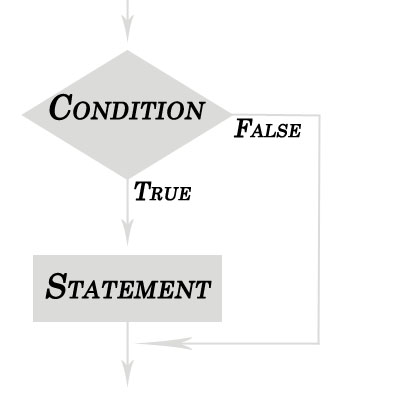
If statements have meaning "if the condition is true, then (statement) command will be done and if it does not qualify then the program will ignored ".
From the above meaning, it can be seen as a flow chart on the image 1. 
Flowchart If.

(Image 1)

The general form of the if statement :


Writing of the conditions should be in parenthesis (......) and the relation of expression and the statement can be either a single statement, compound statement  or a  if (condition) statement; an empty statement, if the use if followed by a compound statement, form of writing as follows:

The general form of the compound in the if statement :


Saturday, March 10, 2012

Friday, March 9, 2012

Thursday, March 8, 2012

TYPE OF OPERATOR C++ Programing Language part 3 : Bitwise operators

Bitwise operators
Bitwise operators are used to manipulate data in the form of bit.

TYPE OF OPERATOR C++ Programing Language part 3 : Bitwise operators

>> Bitwise  Operators  << (Shift Left)

TYPE OF OPERATOR C++ Programing Language part 2 : Operation Relations (Comparative) And Logical operators

Operation Relations (Comparative).
The operator of this relation is used to compare two values. The results of the comparison operator is a numeric value 1 (True) or 0 (False) in C++ Language Program Relation.

TYPE OF OPERATOR C++ Programing Language part 2 : Operation Relations (Comparative) And Logical operators

Logical operators

TYPE OF OPERATOR C++ Programing Language part 1 : Arithmetic operators and Increment and decrement operators.

Arithmetic operators:
Operators for arithmetic operations are classified as binary:

TYPE OF OPERATOR C++ Programing Language part 1 : Arithmetic operators and Increment and decrement operators.

Arithmetic operators are divided into 2 (two):

OPERATOR IN C++ Programming Language

The operator is a symbol or character used to be involved in the program to do operation or manipulation.
Example: Addition, subtraction, division and others.

The operator has the properties:
A. unary
Unary properties of the operator only involves an operand in an arithmetic operation. Example: -5
2. binary
Binary properties the operator involves two operands in an arithmetic operation. Example: 4 + 8
3. ternary
Tenary operator properties involve three operands in an arithmetic operation. Example: (10% 3) + 4 + 2

IDENTIFY COMPONENTS PROGRAM C++ Programing Language

This time we will learn to identify and recognize the structure / component in a program, as well as identify errors that occur in programs that we make.

in the previous post we have studied the structure or component in a program, namely:
1. Identifier (variables, constants, data types and functions).
2. Data types (int, float, char, etc.).
3. Variable Declaration.
4. Assignment / Grading
5. Constants
6. Comment

CONSTANTS AND COMMENT C++ Programming Language

This time we will learn about the basics of programming languages C / C + +.
 
In the programming language C / C + + there are several components that we need to know in advance, and we learn, that is:


CONSTANTS
For declaring constants in C + + is similar to Pascal. The syntax is:


DECLARATION AND ASSIGNMENT VARIABEL C++ Programing Langauge

This time we will learn about the basics of programming languages C / C + +.
 
In the programming language C / C + + there are several components that we need to know in advance, and we learn, that is:


DECLARATION OF VARIABEL
Just as Pascal, variables used in the program must be declared first. Understanding the declaration here is to introduce variables into the program and specify its data type. Here are examples of variable declarations:

DATA TYPES C++ Programming Languages

This time we will learn about the basics of programming languages C / C + +.
 
In the programming language C / C + + there are several components that we need to know in advance, and we learn, that is:


DATA TYPES
There are some types of data we need to know, below are the various types of data.

IDENTIFIER / IDENTITY C++ Programming language

This time we will learn about the basics of programming languages C / C + +.
 
In the programming language C / C + + there are several components that we need to know in advance, and we learn, that is:

IDENTIFIER / IDENTITY 

Identifier is a name commonly used in programming to declare variables, constants, data type, and function. Rules for writing the identifier, among other:
•    Can not start with non-letter characters
•    There should be no spaces

Introduction C++ Programming Languages

This is my first entry in this blog, so first of all I will give some idea about the programming language C + +. Programming language C / C + + is a popular language in teaching in computer science, as well as on the programmer who developed the system software and applications.

Language C / C + + its portable, because the compiler is available almost on all computer architectures and operating systems, so the investment of time and effort you are doing in learning the programming language has a strategic value that is very promising.

Language C / C + + is a language which is strict in the use of data type and the writing is case sensitive, this means that programmers are in demand discipline in the writing program.

Now we'll create a simple program which is quite easy and short.
we will create a program that will produce the output: "Welcome to C + + Programming and Welcome to learn C + + Programming"